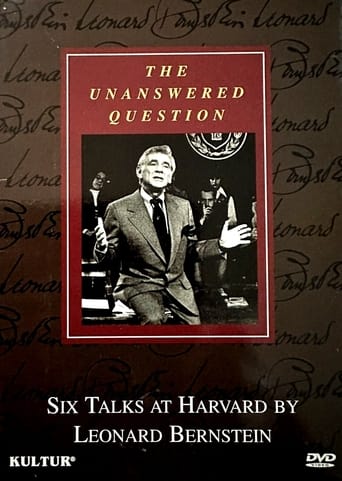
The Unanswered Question - Six Talks at Harvard by Leonard Bernstein
The 1973 Norton Lectures by Leonard Bernstein, presented at his alma mater Harvard University, explores all types of music, including: folk music, pop songs, symphonies, tonal and atonal works; all taught by legendary master composer and conductor, Leonard Bernstein.
Where to Watch
No streaming options found for United States. Try changing your region.
Trying to watch this from United States?
Some content may not be available in your region. Use a VPN to access streaming services from anywhere.
Unlock with NordVPNAffiliate link • We may earn a commission at no extra cost to you
Seasons & Episodes
1. Musical Phonology
Phonology is the linguistic study of sounds, or phonemes. Bernstein's application of this term to music results in what he calls "musical phonology."
2. Musical Syntax
Syntax refers to the study of the structural organization of a sentence, or as Bernstein summarizes, "the actual structures that arise from that phonological stuff" (p. 9). In addition to syntax, lecture 2 relies on Chomsky's theory of universal grammar, which states that innate mental processes take place to transform sounds and words into meaningful structures.
3. Musical Semantics
Semantics is the study of meaning in language, and Bernstein's third lecture, "musical semantics", accordingly, is Bernstein's first attempt to explain meaning in music. Although Bernstein defines musical semantics as "meaning, both musical and extramusical" (p. 9) this lecture focuses exclusively on the "musical" version of meaning.
4. The Delights and Dangers of Ambiguity
Bernstein provides two distinct meanings of the term ambiguity.
5. The Twentieth Century Crisis
Lecture 5 picks up at the early twentieth century with an oncoming crisis in Western Music. As these lectures have traced the gradual increase and oversaturation of ambiguity, Bernstein now designates a point in history that took ambiguity too far. Twelve-tone music emerges as one potential solution to the crisis, but Bernstein considers this idiom so ambiguous that it destroys the all-important balance between clarity and ambiguity.
6. The Poetry of Earth
This lecture takes its name from a line in John Keats' poem, "On the Grasshopper and Cricket". Bernstein does not discuss Keats' poem directly in this chapter, but he provides his own definition of the poetry of earth, which is tonality. Tonality is the poetry of earth because of the phonological universals discussed in lecture 1. This lecture discusses predominantly Stravinsky, whom Bernstein considers the poet of earth.