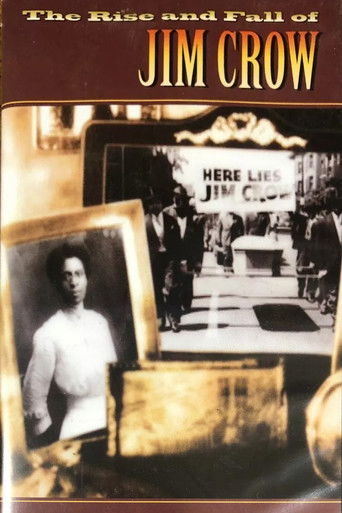
The Rise and Fall of Jim Crow
"Emancipation ended slavery, but not its legacy."
A landmark four-part series exploring segregation from the end of the civil war to the dawn of the modern civil rights movement. Lynchings and beatings by night. Demeaning treatment by day. And a life of crushing subordination for Southern blacks that was maintained by white supremacist laws and customs known as "Jim Crow." It was a brutal and oppressive era in American history, but during this time, large numbers of African Americans and a corps of influential black leaders bravely fought against the status quo, amazingly acquiring for African Americans the opportunities of education, business, land ownership, and a true spirit of community.
Where to Watch
No streaming options found for United States. Try changing your region.
Trying to watch this from United States?
Some content may not be available in your region. Use a VPN to access streaming services from anywhere.
Unlock with NordVPNAffiliate link • We may earn a commission at no extra cost to you
Seasons & Episodes
1. Promises Betrayed (1865-1896)
When the Civil War ended, Reconstruction held much promise for free black men and women. But as the North gradually withdrew support for black aspirations for land, civil and political rights, and legal due process, Southern whites passed laws that segregated and disfranchised African Americans, and reinforced them through violence and terror. By 1876 Reconstruction was over, and new black leaders responded, such as activist/separatist Benjamin "Pap" Singleton, anti-lynching crusader Ida B. Wells, and Booker T. Washington.
2. Fighting Back (1896-1917)
As a successful black middle class arises, white supremacists are determined to destroy its political power, but educator Charlotte Hawkins Brown is among those helping African Americans continue to move forward. Black artists create new genres of American music. An intellectual elite typified by W.E.B. Du Bois, editor of the NAACP magazine THE CRISIS, emerges. Violence at home yields to warfare abroad as thousands of black Americans depart for World War I.
3. Don't Shout Too Soon (1917-1940)
Mob violence, lynchings, and massacres of blacks increase between World Wars I and II, and three members of the fledgling NAACP lead campaigns to confront these threats. W.E.B. Du Bois called for veterans of World War I to "return fighting." Walter White went among the lynchers to discover the truth behind the rapes and insurrections allegedly committed by blacks, and Charles Hamilton Houston designed and successfully applied a legal strategy that challenged Jim Crow and resulted in the famous "Brown vs. Board of Education" decision, which desegregated public schools in 1954.
4. Terror and Triumph (1940-1954)
Amid the surge of black activism following World War II, prolonged legal battles led to Supreme Court decisions that opened doors and restored voting rights for blacks. The battle for freedom, dignity, and opportunity throughout America continued through the '50s and '60s -- and in many respects, continues today.